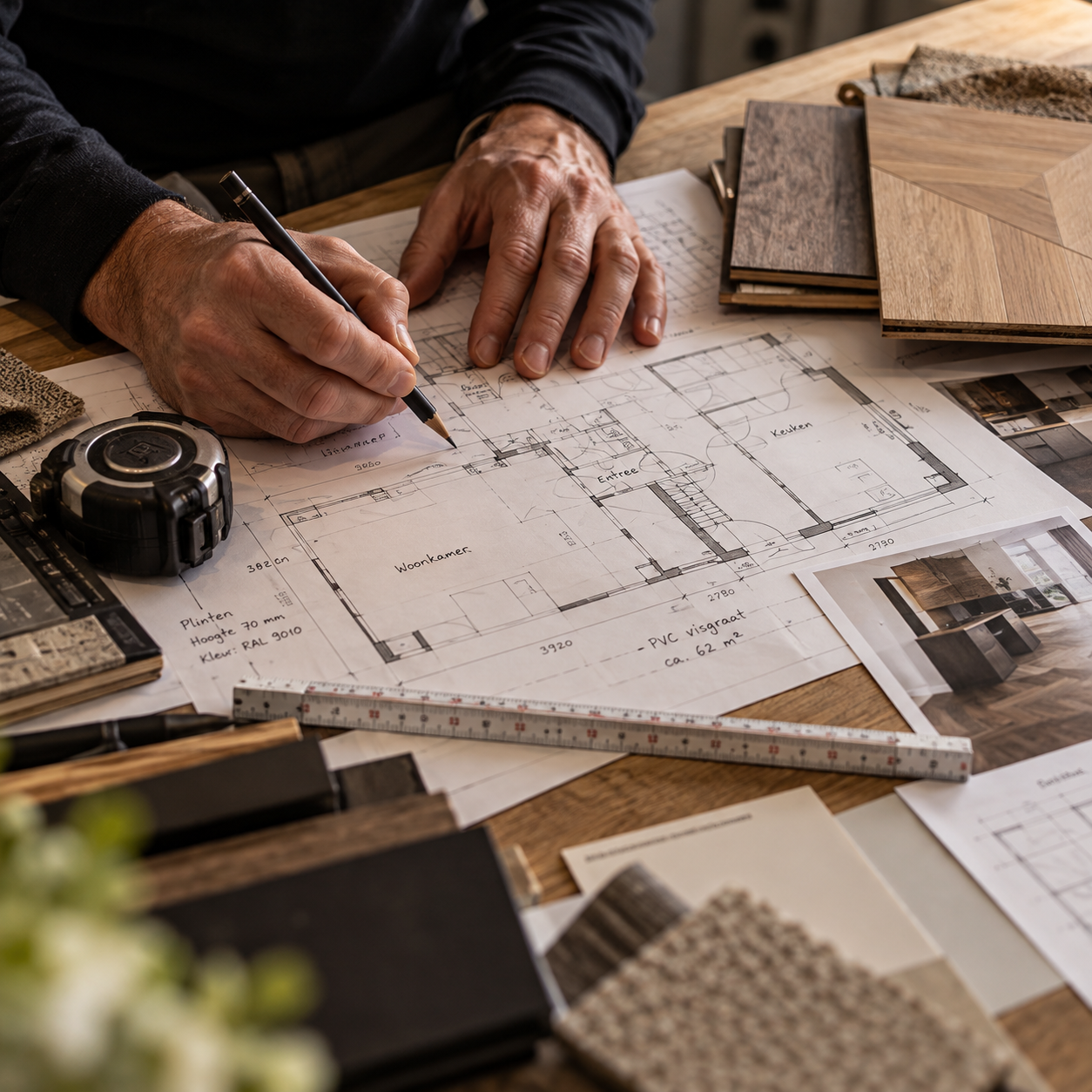
Choosing a PVC floor: glue-down or click PVC – what suits your home?
Glue-down or click PVC? Discover the differences and choose the right PVC floor for your home.
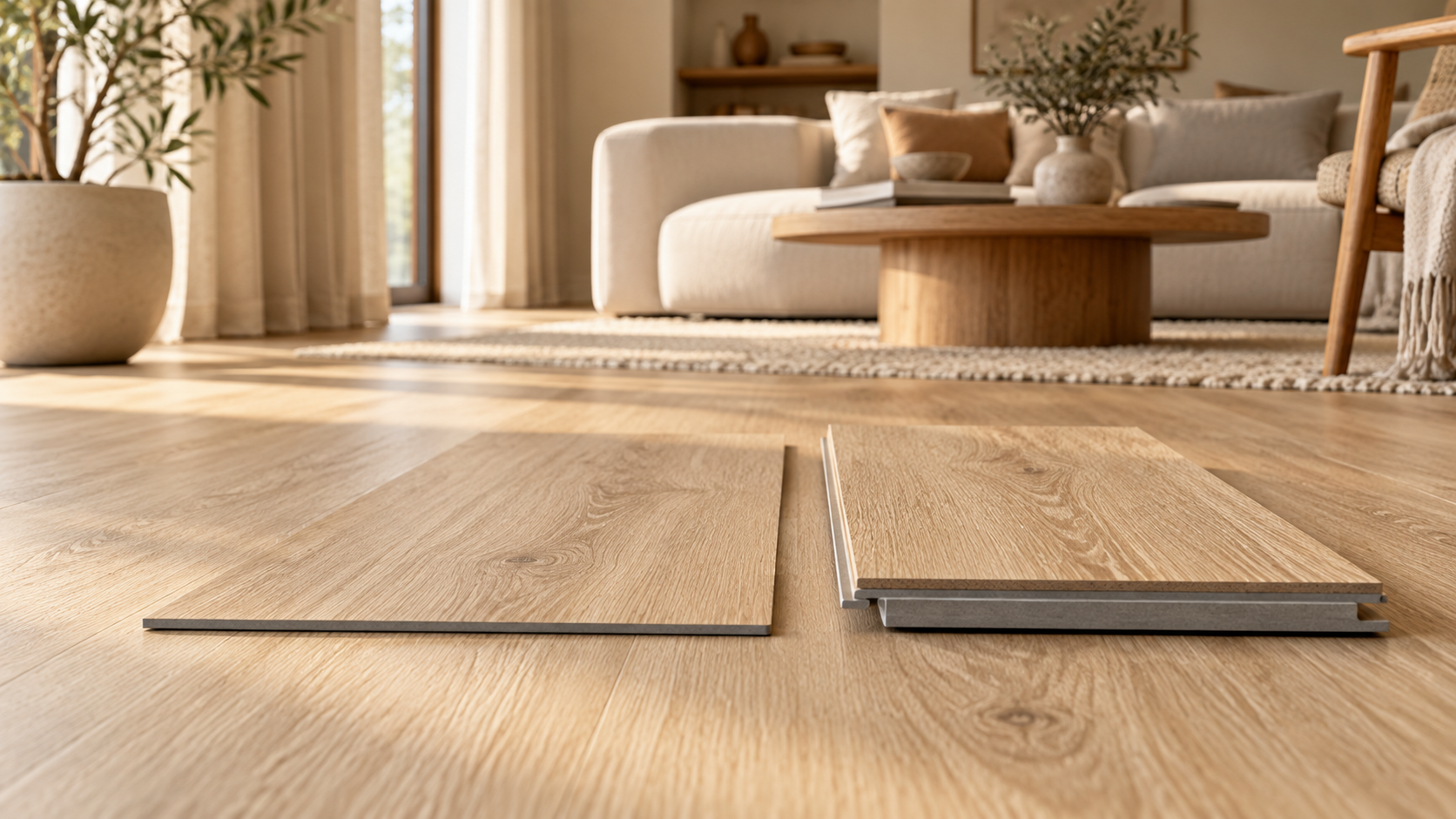
Glue-down or click PVC: what suits your home?
PVC is one of the most popular floor types at the moment. That is not surprising. PVC is strong, low-maintenance, available in many different styles and can be combined well with underfloor heating in many homes.
Yet one important question often arises when choosing PVC:
Do you choose glue-down PVC or click PVC?
At first glance both floors can look almost the same. The biggest difference lies mainly in how the floor is laid and in the demands placed on the subfloor.
That is why it is wise not to look only at colour and design.
The right question is:
Which PVC solution technically suits your home best?
What is glue-down PVC?
Glue-down PVC is bonded directly to a suitable subfloor.
This floor is also known as dryback PVC.
The PVC strips are relatively thin and are fixed to the subfloor. This creates a sleek floor that hardly moves.
Glue-down PVC is often chosen when:
- a low floor build-up is desired;
- underfloor heating is present;
- a sleek end result is important;
- herringbone or Hungarian point is desired;
- different rooms need to flow into each other nicely;
- the subfloor can be well prepared.
With glue-down PVC the preparation of the subfloor is particularly important.
Because the floor is relatively thin, unevenness can become visible later.
Why does the subfloor have to be so flat with glue-down PVC?
A beautiful PVC floor doesn't start with the plank.
It starts with the subfloor.
Before glue-down PVC is bonded, the floor must be flat, clean, dry and stable.
That is why in many situations the subfloor is levelled first.
Levelling removes small height differences and irregularities. This creates a smooth base on which the PVC floor can be neatly bonded.
That is important for both the look and the lifespan of the floor.
What is click PVC?
Click PVC consists of planks that are joined together with a click system.
The floor is usually laid floating. That means it is not bonded directly to the subfloor.
Click PVC can be interesting when:
- gluing is not desired;
- the existing subfloor is suitable;
- a floating floor is preferred;
- the floor must be relatively easy to remove later;
- it is a renovation;
- quick installation is important.
Click PVC is usually thicker than glue-down PVC.
That is because the plank has a load-bearing core in which the click system is incorporated.
Is click PVC always easier?
Not automatically.
Because click PVC is not glued, it sometimes seems as if the subfloor matters less.
But with click PVC too, the base must be sufficiently flat and stable.
A suitable underlay may also be needed.
The total floor height also plays a role.
Think, for example, of:
- doors;
- thresholds;
- skirting boards;
- kitchen layouts;
- connections to other rooms.
A few extra millimetres of floor height can already make a difference in some homes.
That is why we prefer to look at the complete floor build-up in advance.
Glue-down or click PVC with underfloor heating?
Both glue-down PVC and click PVC can be used in combination with underfloor heating in many situations.
Yet there is an important difference.
With glue-down PVC the total floor build-up is usually relatively thin. As a result heat can pass through the floor relatively easily.
With click PVC the floor system consists of several layers.
Think of:
- the PVC floor;
- any underlay;
- the existing subfloor.
That is why with underfloor heating the total thermal resistance of the complete floor system must always be looked at.
Not only the PVC plank itself.
When is glue-down PVC often a good choice?
Glue-down PVC can be interesting in new-build homes and renovations where the subfloor can be well prepared.
With underfloor heating too, glue-down PVC is often chosen because of its low build-up.
Glue-down PVC is also popular for laying patterns such as:
- herringbone;
- Hungarian point;
- wide planks;
- continuous floors across several rooms.
Because the floor is bonded, it often feels sleek and solid.
When is click PVC often a good choice?
Click PVC can be practical when you would rather not glue a floor.
For example when:
- the existing subfloor is suitable;
- you want to be able to remove the floor later;
- you are carrying out a renovation;
- you prefer to work with a floating floor system.
It remains important to check whether the subfloor is suitable.
A poor subfloor does not automatically become good because you use click PVC.
What is the difference in feel?
Glue-down PVC is bonded directly to the subfloor.
As a result the floor usually feels very solid and direct.
Click PVC is laid floating.
As a result the walking feel can be slightly different.
How big that difference is depends strongly on:
- the quality of the floor;
- the underlay used;
- the subfloor;
- the construction of the product.
That is why it is smart to see and feel different systems in person.
Is glue-down PVC more expensive than click PVC?
You can't tell that from the price per square metre alone.
With glue-down PVC, for example, extra costs can arise for:
- levelling;
- glue;
- preparation;
- professional installation.
With click PVC, costs can arise for:
- an underlay;
- adjustments to doors;
- extra floor height;
- preparation of the existing floor.
That is why we advise always comparing the total picture.
Not only the price of the plank, but the complete floor.
What happens if you choose wrong?
A PVC floor usually stays in the home for years.
That is why it is annoying if you only discover after laying that:
- the floor ends up too high;
- doors no longer open properly;
- the subfloor wasn't flat enough;
- underfloor heating works less well than expected;
- the chosen pattern looks too busy;
- the floor technically doesn't suit the home.
Many of these problems can be prevented in advance.
Not by looking at more designs.
But by first properly assessing the home.
The home first, then the floor
At NTU Vloeren we therefore prefer to start with the situation.
We look at, among other things:
- the existing subfloor;
- underfloor heating;
- available build-up height;
- connections to other rooms;
- doors and thresholds;
- intensity of use;
- desired look;
- budget.
Only then does the choice between glue-down and click PVC become really clear.
After that the fun part begins:
the colour, the pattern and the look.
Which look suits your interior?
PVC is available in an enormous number of versions.
Think, for example, of:
- light oak planks;
- warm wood tones;
- herringbone;
- Hungarian point;
- wide planks;
- concrete look;
- natural stone look.
The right choice doesn't depend only on taste.
The size of the room, amount of daylight and furnishing also play a part.
A floor that looks calm in a showroom can look very different in a smaller room.
That is why it is wise to view several large samples side by side.
Large samples make choosing easier
A small sample tells only part of the story.
With larger samples you can better see:
- how the wood grain runs;
- how light affects the colour;
- how matt or glossy the surface is;
- how different planks look together;
- how a pattern turns out;
- how the floor combines with furniture and kitchen.
That makes it much easier to make a good choice.
See glue-down or click PVC in Utrecht?
Unsure between glue-down PVC and click PVC?
Then visit NTU Vloeren in Utrecht.
In our showroom you can view different PVC floors, colours, patterns and systems side by side.
We look together at your home, subfloor and wishes.
That way we first choose the right floor system.
After that, choosing the look becomes a lot easier.
Visit NTU Vloeren at the home-furnishing boulevard in Utrecht, next to IKEA, for personal advice on your PVC floor.