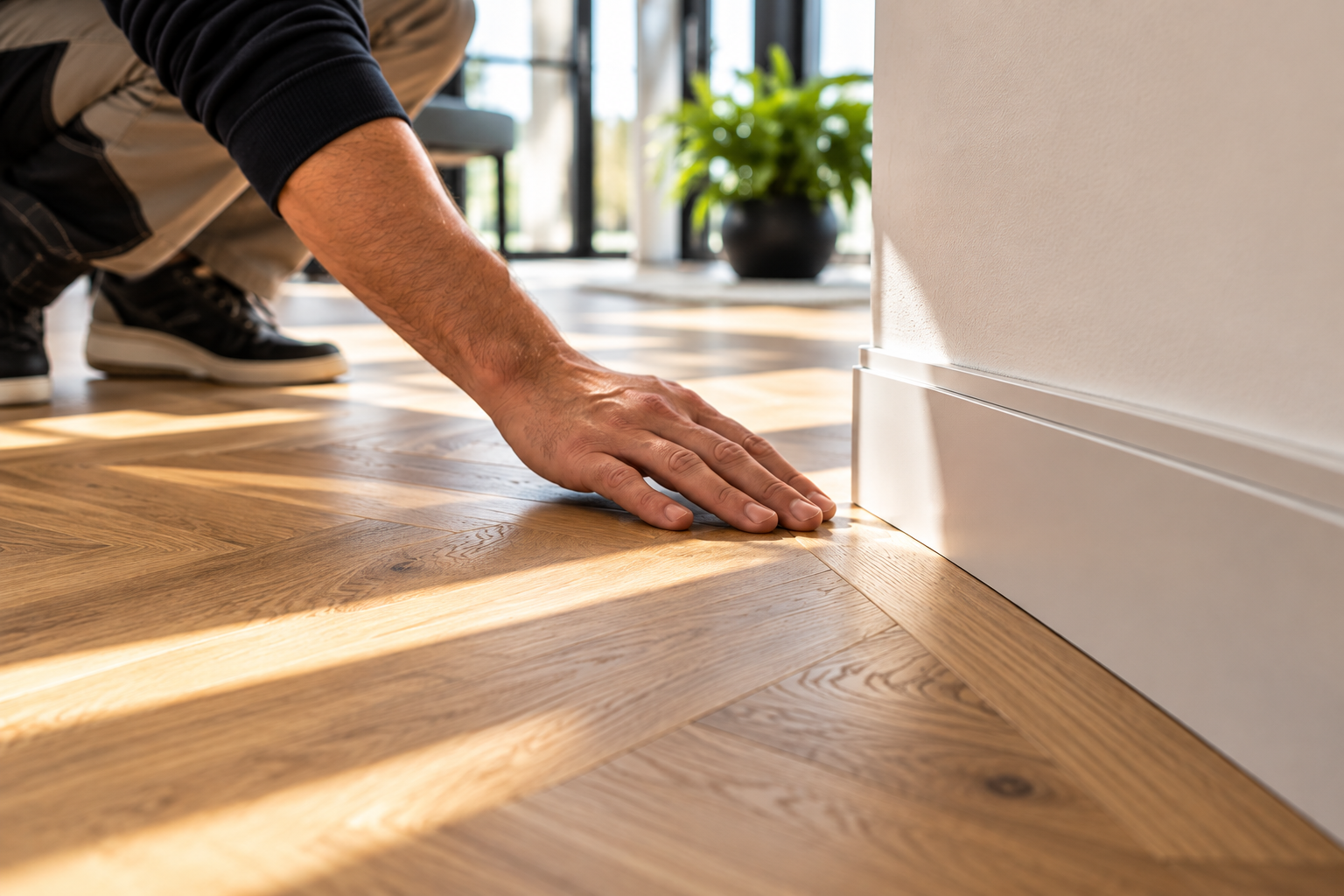

Old floor out or just lay over it?
You have chosen a new floor.
Then the next question often comes up:
Does the existing floor have to be removed completely, or can the new floor simply go over it?
The attractive answer is of course: just leave it.
That saves demolition work, waste, time and costs.
But technically that is not always the best solution.
Whether an existing floor can stay depends on several factors.
At NTU Vloeren we therefore prefer to first look at what is actually under the new floor.
Why the existing floor matters so much
A new floor can only function well when the base is stable.
An existing floor that:
- is loose;
- moves;
- is damaged;
- is not flat;
- has moisture problems;
- adds too much height;
can cause problems later.
That is why we don't only look at the new floor.
We look at the entire floor build-up.
Can a new floor go over tiles?
In some situations, yes.
A stable tiled floor can be a perfectly good base for a new floor.
But first it must be checked whether:
- all tiles are firmly attached;
- there are no large height differences;
- the grout lines are not too deep;
- the floor is clean and grease-free;
- the total floor height is not a problem.
With glue-down PVC, for example, the tiled floor will often first have to be prepared and levelled.
The grout lines must not ultimately become visible in the new floor.
Can PVC go over an existing floor?
That depends on the type of PVC.
Glue-down PVC
Glue-down PVC needs a very flat and stable subfloor.
An existing floor can therefore usually not just stay.
Often preparation or levelling is needed first.
Click PVC
Click PVC can in some situations be laid over a suitable existing floor.
But even then that floor must be:
- flat;
- stable;
- dry;
- sufficiently hard.
A problem under the existing floor does not disappear because a new floor is placed on top.
Can laminate go over an existing floor?
That is sometimes possible too.
For example when there is a stable hard floor.
But then account must be taken of:
- the right underlay;
- available height;
- doors;
- thresholds;
- underfloor heating;
- any movement of the old floor.
Simply laying two floating floors on top of each other is not always wise.
That is why it must first be clear how the existing construction is built up.
And what do we do with existing parquet?
An existing wooden floor needs extra attention.
Sometimes it can stay.
Sometimes it can even be renovated.
But wood is a material that moves.
That is why we look at, among other things:
- stability;
- moisture;
- damage;
- bonding;
- movement;
- flatness.
It can be a shame to remove a good-quality wooden floor straight away.
But using an unstable wooden floor as a base is equally unwise.
Carpet usually has to be removed
A soft floor covering is usually not a suitable base for a hard new floor.
That is why existing carpet is generally removed.
Something else may then come to light underneath.
For example:
- concrete;
- sand-cement screed;
- wood;
- old glue;
- levelling compound.
Only then can it be properly assessed what preparation is needed.
Old glue residues can cause problems
When an existing floor is removed, the subfloor doesn't always remain nicely clean.
There may, for example, be residues of:
- carpet glue;
- PVC glue;
- tile adhesive;
- bitumen-like products.
Those residues must be assessed before a new floor build-up is applied.
Sometimes they can be prepared.
In other situations they must be removed first.
Underfloor heating changes the choice
Do you have underfloor heating?
Then the total floor build-up becomes even more important.
Every extra layer adds extra thermal resistance.
Leaving an old floor in place and then laying an underlay and new floor on top can affect heat transfer.
That is why with underfloor heating we don't only look at:
“Is it possible?”
But above all at:
“Is it technically sensible?”
Watch the total floor height
This is regularly underestimated.
Leaving an old floor means the new floor goes on top of it.
A few millimetres seems little.
But it can affect:
- doors;
- thresholds;
- kitchen plinths;
- sliding doors;
- stairs;
- connections to other rooms.
In a complete renovation you therefore have to look at all rooms together.
Sometimes removal is cheaper in the end
It seems cheaper to leave an old floor in place.
But if extra solutions are needed later as a result, that advantage can disappear.
Think, for example, of:
- shortening doors;
- transition profiles;
- solving height differences;
- problems with underfloor heating;
- repairing an unstable subfloor.
That is why we prefer to look at the total costs.
Not only at avoiding demolition.
And sometimes removal is precisely unnecessary
The reverse is equally true.
Removing a good, stable existing subfloor when that is not technically necessary costs:
- labour;
- time;
- waste;
- money.
That is why we also don't believe in simply saying:
“Everything has to go.”
We first want to know what is there.
How do we assess the existing floor?
At NTU Vloeren we look at, among other things:
- which material is there;
- how stable the floor is;
- flatness;
- moisture;
- existing damage;
- underfloor heating;
- the desired new floor;
- total floor height;
- transitions to other rooms.
Only then do we determine what is sensible.
Investigate first, demolish later
Deciding to remove a floor is quick.
But once removed, you can't put it back.
That is why it is often smarter to take a good look first.
Perhaps the existing floor can serve perfectly well as a base.
Perhaps only a part needs to be adjusted.
Or perhaps removal turns out to be the only sensible solution.
You only know that when you assess the existing situation.
Renovation? Look at the complete picture
With a renovation, several jobs often come together.
New kitchen.
New doors.
Underfloor heating.
Plastering.
New floor.
Then the floor height must be taken into account early.
When every party only looks at its own part, problems often arise later at the connections.
That is why at NTU we prefer to look at the whole.
Remove or keep the old floor in Utrecht?
Are you renovating and unsure what to do with your existing floor?
Then visit NTU Vloeren in Utrecht.
We look at the current situation and at the floor you ultimately want.
That lets us determine which preparation is really needed.
Not doing more than necessary.
But also not skipping important steps.
Visit our showroom at the home-furnishing boulevard in Utrecht, next to IKEA, and discuss the floor build-up of your home.